BINARYOLOGY
Why does binary keep appearing wherever humanity seeks, represents, or creates intelligence?
From ancient Providence systems to Shannon information theory, modern computing, artificial intelligence, and contemporary questions about reality itself, Binaryology investigates the recurring power of two-state structures without assuming that science, religion, philosophy, and technology are the same thing.
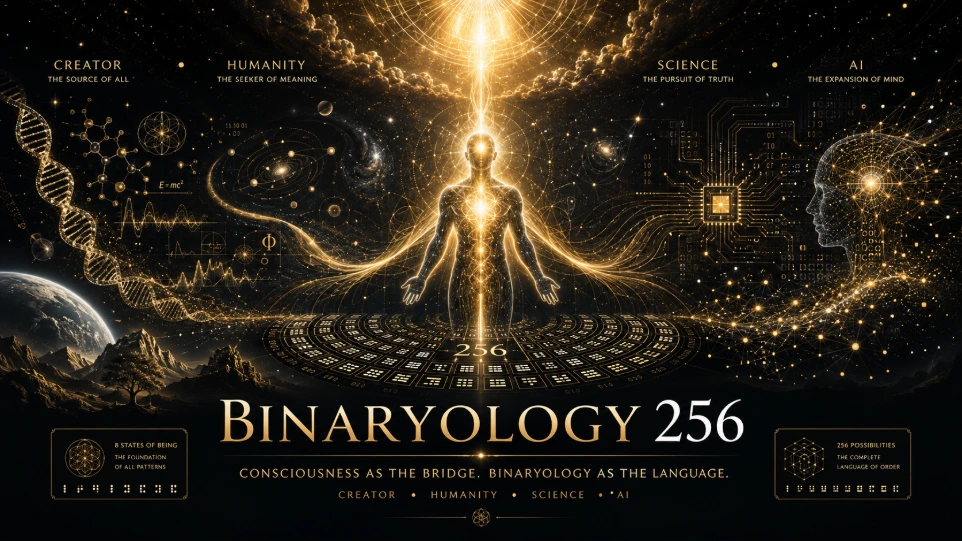
What is Binaryology?
Binary begins with an extremely simple distinction: two states. Yet combinations of those states can represent language, images, sound, software, models, and artificial intelligence.
Long before electronic computers, some traditional knowledge systems also used paired or two-state patterns to organize meaning and seek guidance. Binaryology asks why this structure is so powerful and why it appears across very different human attempts to understand reality.
Binaryology is not the claim that everything is binary. It is an interdisciplinary inquiry into how binary and other two-state structures represent information, generate complexity, support intelligence, and participate in humanity's search for meaning.
From binary arithmetic to artificial intelligence.
Binaryology builds on recognized intellectual traditions. It does not replace them. The research distinguishes established mathematics and information science from historical comparison, computational models of reality, philosophical hypotheses, and theological interpretation.
Leibniz — Binary Arithmetic
Formalized and publicized arithmetic using 0 and 1, showing how complex numerical representation can arise from two symbols.
Shannon — Information Theory
Established a mathematical theory of communication in which information can be measured in binary digits, or bits.
Zuse / Fredkin — Computational Reality
Advanced serious but contested ideas that physical reality may be describable through discrete informational or computational processes.
Bostrom — Simulation Argument
Formulated the modern philosophical argument concerning the possibility of advanced civilizations creating simulated worlds.
Ifá — 256 Odù
Preserves a culturally distinct 256-pattern knowledge architecture associated with interpretation, wisdom, guidance, and Providence.
Artificial Intelligence
Shows humanity using digital information systems to create increasingly capable machine intelligence, reopening questions about agency, emergence, and creation.
Meaning and mechanism can meet without becoming the same thing.
The Interpreter
Information does not become understanding automatically. Human consciousness brings memory, emotion, intuition, reason, values, context, and purpose to what we perceive.
The Investigator
Science helps test observable claims. Binaryology uses scientific evidence as evidence — not as automatic proof of spiritual or metaphysical propositions.
Created Intelligence
Humans now use binary computation to create increasingly capable artificial intelligence. Binaryology asks what that act of creation may teach us about intelligence, emergence, and ourselves.
From two states to 256 possibilities.
Shannon information theory gives modern science a rigorous language for thinking about discrete alternatives and information. Eight two-state positions can form 28 = 256 possible states.
The Yoruba Ifá tradition also preserves a corpus organized around 256 Odù, each associated with its own signature, verses, teachings, interpretations, and guidance.
Binaryology does not claim that Ifá invented computing or that the two systems share a proven historical origin. It treats the structural correspondence as a research-worthy question.
Does the pattern remain relevant across religious traditions?
Binaryology will investigate ancient systems used to seek divine, spiritual, or providential guidance and compare their underlying information structures. The research does not begin by assuming that Ifá is the only such system.
A second workstream asks whether themes identified through the 256 Odù have meaningful parallels in major sacred-text traditions — including the Bible, Qur'an, Torah / Hebrew Bible, Hindu traditions, Buddhist traditions, and others as appropriate expertise becomes available.
The objective is not to prove that these traditions contain the same binary code. It is to compare themes, meanings, and human questions while preserving each tradition's doctrinal and historical distinctiveness.
Information, reality, creation, and evolution.
The Simulation Question
Contemporary simulation and information-based hypotheses ask whether observable reality may emerge from deeper rules, states, information, or computation. Binaryology does not assume that the universe literally runs on binary code or that the simulation hypothesis is established science.
Why are simple discrete states so effective at representing and generating complex systems — and could that effectiveness tell us something deeper about reality?
Creation and Evolution
Binaryology does not begin by treating creation and evolution as mutually exclusive. Creation may concern origin, order, rules, information, and possibility; evolution may concern development, adaptation, selection, emergence, and increasing complexity within those conditions.
Can creation occur through systems capable of evolution?
What Binaryology is investigating.
256 BINARYOLOGY turns the research into an experience.
The 256 BINARYOLOGY public beta is a digital reflection and research environment. It uses the 256 Odù as its foundational wisdom structure and allows visitors to explore Providence, interpretation, guidance, and related wisdom through multiple perspectives.
Traditional (Ifá / Ìṣẹ̀ṣe), Christian, Muslim, and Interfaith perspectives can provide different interpretive lenses while expert review and governance improve the quality of relationships over time.
Modern digital intelligence helps organize material, identify relationships, and make the experience accessible. It does not determine what a visitor must believe.
What Binaryology is — and what it is not.
Binaryology is not a new religion. It does not ask visitors to abandon or adopt a particular faith.
It does not claim that Ifá invented modern computing, that the universe has been proven to be binary, that the simulation hypothesis is established fact, or that artificial intelligence proves the existence of a Creator.
It separates established scientific findings, structural analogies, philosophical hypotheses, cultural knowledge systems, and religious interpretations.
Its purpose is not to tell you what to believe. Its purpose is to investigate relationships and help deepen understanding.
Partner with Binaryology.
Binaryology is an interdisciplinary research initiative of the LADIOM Institute of Understanding. We welcome conversations with universities, researchers, foundations, philanthropic sponsors, cultural institutions, technology organizations, and strategic investors interested in helping advance the work.
Research & Academic Partnership
Universities, scholars, research institutes, religious experts, cultural experts, and interdisciplinary collaborators.
Foundation & Sponsorship Support
Support for research, knowledge preservation, expert validation, comparative study, publication, and public education.
Strategic Investment
Partners interested in the digital platform, intellectual property, research infrastructure, and future applications of Binaryology.
Bring a purpose. Receive a pattern. Explore the wisdom. Decide what it means.
256 BINARYOLOGY is currently in public beta while research, expert review, and validation continue.
BINARYOLOGY
Why does binary keep appearing wherever humanity seeks, represents, or creates intelligence?
From ancient Providence systems to Shannon information theory, modern computing, artificial intelligence, and contemporary questions about reality itself, Binaryology investigates the recurring power of two-state structures without assuming that science, religion, philosophy, and technology are the same thing.
What is Binaryology?
Binary begins with an extremely simple distinction: two states. Yet combinations of those states can represent language, images, sound, software, models, and artificial intelligence.
Long before electronic computers, some traditional knowledge systems also used paired or two-state patterns to organize meaning and seek guidance. Binaryology asks why this structure is so powerful and why it appears across very different human attempts to understand reality.
Binaryology is not the claim that everything is binary. It is an interdisciplinary inquiry into how binary and other two-state structures represent information, generate complexity, support intelligence, and participate in humanity's search for meaning.
From binary arithmetic to artificial intelligence.
Binaryology builds on recognized intellectual traditions. It does not replace them. The research distinguishes established mathematics and information science from historical comparison, computational models of reality, philosophical hypotheses, and theological interpretation.
Leibniz — Binary Arithmetic
Formalized and publicized arithmetic using 0 and 1, showing how complex numerical representation can arise from two symbols.
Shannon — Information Theory
Established a mathematical theory of communication in which information can be measured in binary digits, or bits.
Zuse / Fredkin — Computational Reality
Advanced serious but contested ideas that physical reality may be describable through discrete informational or computational processes.
Bostrom — Simulation Argument
Formulated the modern philosophical argument concerning the possibility of advanced civilizations creating simulated worlds.
Ifá — 256 Odù
Preserves a culturally distinct 256-pattern knowledge architecture associated with interpretation, wisdom, guidance, and Providence.
Artificial Intelligence
Shows humanity using digital information systems to create increasingly capable machine intelligence, reopening questions about agency, emergence, and creation.
Meaning and mechanism can meet without becoming the same thing.
The Interpreter
Information does not become understanding automatically. Human consciousness brings memory, emotion, intuition, reason, values, context, and purpose to what we perceive.
The Investigator
Science helps test observable claims. Binaryology uses scientific evidence as evidence — not as automatic proof of spiritual or metaphysical propositions.
Created Intelligence
Humans now use binary computation to create increasingly capable artificial intelligence. Binaryology asks what that act of creation may teach us about intelligence, emergence, and ourselves.
From two states to 256 possibilities.
Shannon information theory gives modern science a rigorous language for thinking about discrete alternatives and information. Eight two-state positions can form 28 = 256 possible states.
The Yoruba Ifá tradition also preserves a corpus organized around 256 Odù, each associated with its own signature, verses, teachings, interpretations, and guidance.
Binaryology does not claim that Ifá invented computing or that the two systems share a proven historical origin. It treats the structural correspondence as a research-worthy question.
Does the pattern remain relevant across religious traditions?
Binaryology will investigate ancient systems used to seek divine, spiritual, or providential guidance and compare their underlying information structures. The research does not begin by assuming that Ifá is the only such system.
A second workstream asks whether themes identified through the 256 Odù have meaningful parallels in major sacred-text traditions — including the Bible, Qur'an, Torah / Hebrew Bible, Hindu traditions, Buddhist traditions, and others as appropriate expertise becomes available.
The objective is not to prove that these traditions contain the same binary code. It is to compare themes, meanings, and human questions while preserving each tradition's doctrinal and historical distinctiveness.
Information, reality, creation, and evolution.
The Simulation Question
Contemporary simulation and information-based hypotheses ask whether observable reality may emerge from deeper rules, states, information, or computation. Binaryology does not assume that the universe literally runs on binary code or that the simulation hypothesis is established science.
Why are simple discrete states so effective at representing and generating complex systems — and could that effectiveness tell us something deeper about reality?
Creation and Evolution
Binaryology does not begin by treating creation and evolution as mutually exclusive. Creation may concern origin, order, rules, information, and possibility; evolution may concern development, adaptation, selection, emergence, and increasing complexity within those conditions.
Can creation occur through systems capable of evolution?
What Binaryology is investigating.
256 BINARYOLOGY turns the research into an experience.
The 256 BINARYOLOGY public beta is a digital reflection and research environment. It uses the 256 Odù as its foundational wisdom structure and allows visitors to explore Providence, interpretation, guidance, and related wisdom through multiple perspectives.
Traditional (Ifá / Ìṣẹ̀ṣe), Christian, Muslim, and Interfaith perspectives can provide different interpretive lenses while expert review and governance improve the quality of relationships over time.
Modern digital intelligence helps organize material, identify relationships, and make the experience accessible. It does not determine what a visitor must believe.
What Binaryology is — and what it is not.
Binaryology is not a new religion. It does not ask visitors to abandon or adopt a particular faith.
It does not claim that Ifá invented modern computing, that the universe has been proven to be binary, that the simulation hypothesis is established fact, or that artificial intelligence proves the existence of a Creator.
It separates established scientific findings, structural analogies, philosophical hypotheses, cultural knowledge systems, and religious interpretations.
Its purpose is not to tell you what to believe. Its purpose is to investigate relationships and help deepen understanding.
Partner with Binaryology.
Binaryology is an interdisciplinary research initiative of the LADIOM Institute of Understanding. We welcome conversations with universities, researchers, foundations, philanthropic sponsors, cultural institutions, technology organizations, and strategic investors interested in helping advance the work.
Research & Academic Partnership
Universities, scholars, research institutes, religious experts, cultural experts, and interdisciplinary collaborators.
Foundation & Sponsorship Support
Support for research, knowledge preservation, expert validation, comparative study, publication, and public education.
Strategic Investment
Partners interested in the digital platform, intellectual property, research infrastructure, and future applications of Binaryology.
Bring a purpose. Receive a pattern. Explore the wisdom. Decide what it means.
256 BINARYOLOGY is currently in public beta while research, expert review, and validation continue.